The Future of Culture
, 2025
Published version in Expresso newspaper on July 25, 2025.
The Future of Culture is an essay by Guta Moura Guedes on the importance of culture as one of the four pillars of sustainability.
This short version was published in the Expresso newspaper on July 25, 2025.
The essay also forms the basis of the lecture The Future of Culture, presented by GMG at Spirit of Paimio 2025, at the invitation of the Paimio Sanatorium Foundation in Finland.
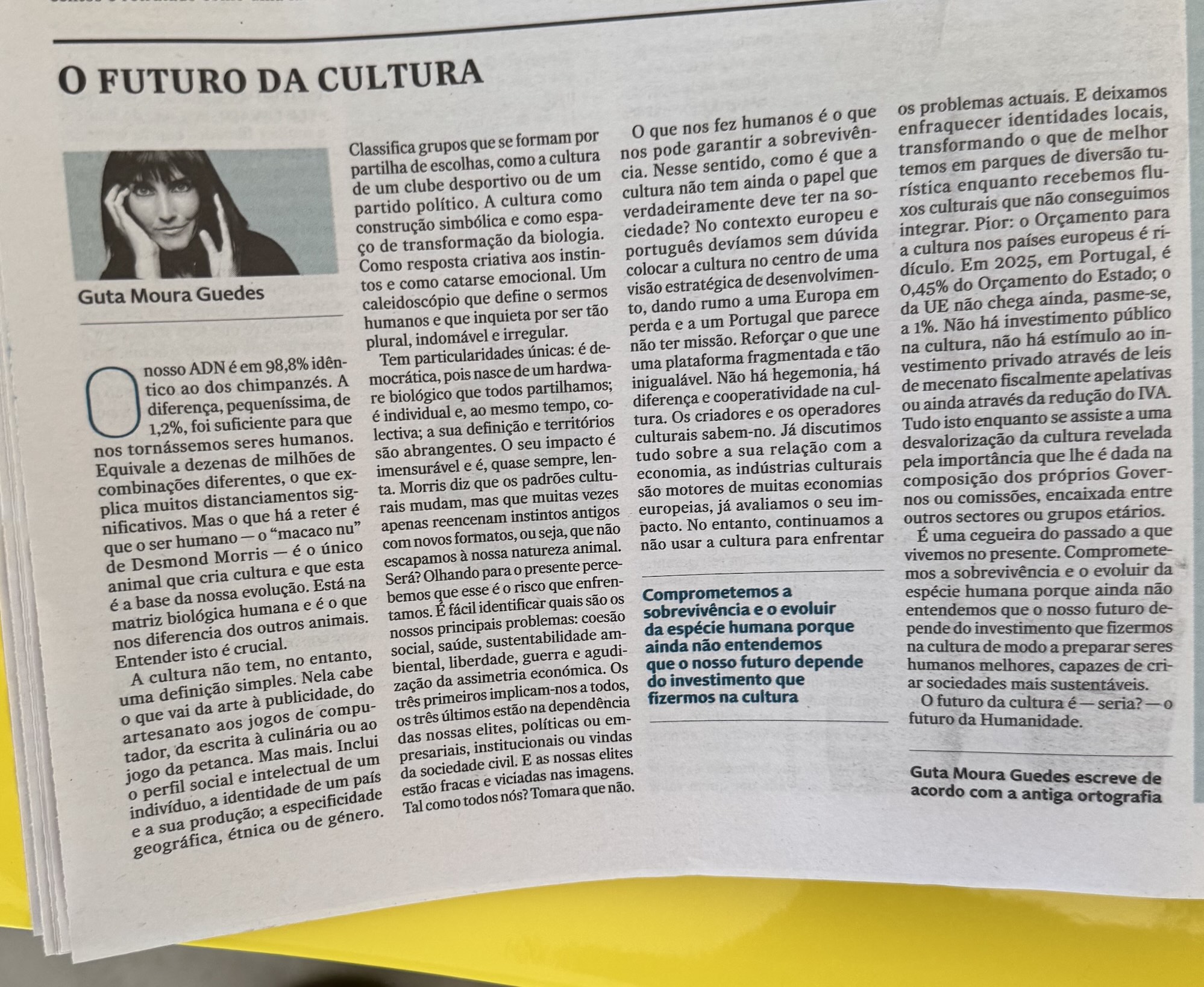
“The Future of Culture
Our DNA is 98.8% identical to that of chimpanzees. The tiny 1.2% difference was enough to make us human. It amounts to tens of millions of different combinations, which explains many of the more significant divergences. But what matters most is this: the human being – Desmond Morris’s “naked ape” – is the only animal that creates culture, and culture is the foundation of our evolution. It is embedded in the biological matrix of humanity, and it is what sets us apart from other animals. Understanding this is crucial.
Culture, however, defies a simple definition. It spans everything from art to advertising, from craft to video games, from literature to cuisine or the game of pétanque. And more. It includes the social and intellectual profile of an individual, the identity and output of a nation; it reflects geographic, ethnic, or gender-specific traits. It defines groups that form through shared affinities — the culture of a football club, a political party. Culture as symbolic construction and as a space where biology is transformed. As a creative response to instinct and a site of emotional catharsis. A kaleidoscope that defines our humanity and unsettles us by being so plural, unruly, and irregular.
It has unique traits: it is democratic, as it springs from a biological hardware we all share; it is both individual and collective; its definitions and domains are expansive. Its impact is immeasurable — and nearly always slow to unfold. Morris says that cultural patterns do change, but often only reenact ancient instincts in new formats; in other words, that we do not escape our animal nature. Is that so? Looking at the present, we realise this may indeed be the danger we face. Our key challenges are not hard to identify: social cohesion, public health, environmental sustainability, freedom, war, and the worsening of economic disparity. The first three implicate us all; the last three depend largely on our elites — political, corporate, institutional, or emerging from civil society. And our elites are weakened, addicted to appearances. As are we all? Let us hope not.
What made us human is also what might ensure our survival. In this sense, how is it possible that culture still does not hold the central role it must in society? In both the European and Portuguese contexts, we should, without hesitation, place culture at the heart of a strategic vision for development — to give direction to a faltering Europe and a Portugal that seems to lack a sense of mission. To strengthen what unites a fragmented and unparalleled platform. There is no hegemony in culture — there is difference, and there is coopetition. Creators and cultural agents know this well. We have already debated its relationship with the economy; the cultural and creative industries are engines of many European economies. We have measured its impact. And yet, we still fail to use culture to address today’s urgent problems. We let local identities wither, turning the best we have into amusement parks for tourists, while receiving cultural flows we are unable to integrate. Worse still: the public budget for culture across European countries is paltry. In 2025, in Portugal, it stands at 0.45% of the state budget; the EU’s cultural budget still, astonishingly, does not reach 1%. There is no significant public investment in culture, no real incentive for private investment through tax-deductible patronage or VAT reductions. All this while culture is being devalued, reflected in the negligible weight it carries in the composition of governments and commissions, tucked away between other sectors or age-related groups.
This is a blindness of the past, playing out in the present. We are compromising the survival and evolution of our species because we have yet to grasp that our future depends on the investment we make in culture – the key to preparing better human beings, capable of building more sustainable societies.
The future of culture is — or would be? — the future of humanity.”
GMG, 25 July 2025, Expresso Newspaper.